
Thursday, October 15, 2009


Monday, October 12, 2009


Thursday, October 8, 2009
Pre-report trade estimates
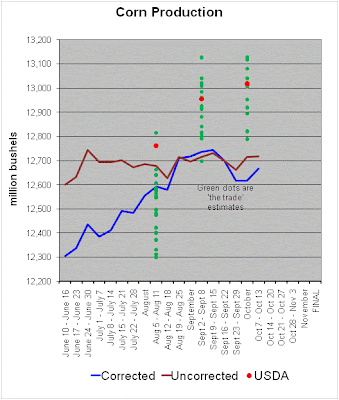
Here are the trade estimates of the UDSA numbers for tomorrow. As you can see I'm way down at the edge of the corn yield estimates. This may be a year when I simply am much farther off from the USDA estimates. I'm right in the thick of it for soybeans, both yield and production. For cotton, I had some early sucess when I first built the model in predicting yields, but since this point, the model has been subject to error, much of it driven by the results in Texas.
However, at this point, the USDA still has historically made big adjustments between the October estimates and the final estimate (see the 2 posts before this one). The November estimates tend to be much closer to the final estimates.


However, at this point, the USDA still has historically made big adjustments between the October estimates and the final estimate (see the 2 posts before this one). The November estimates tend to be much closer to the final estimates.


Comparing USDA and Model Performance
In case you didn't look at the previous post, the dots are the mean and +/- 1 standard deviation for the USDA of the error of thier monthly estimate compared to the final. The lines are the same for my uncorrected model.
Here are some state by state comparisons of my error bounds each week relative to those of the USDA. As you can see I tend to be fairly competitive up until the October report. After the October report my error bounds don't decline, because I'm getting no new information. Now of course my errors are in-sample and the USDA errors are out of sample, but my error bounds are very similar to the USDA when looking at the October report. There is still room and precedent for the USDA to make pretty good changes to the yield estimate after October. For instance, the graph for Illinois corn shows a standard deviation of the change from October to Final of 5bushels. For my bounds I'm showing the uncorrected model. The corrected model simply takes my mean error each week and centers it back on zero, so the width doesn't change, I just recenter it. These graphs also show that the USDA has historically had a pattern to their estimates as they are not centered on zero.
Illinois Corn

Iowa Corn

Indiana Corn

Nebraska Corn

Missouri Corn

Minnesota Corn

Ohio Corn

Illinois Soybean

Iowa Soybean

Indiana Soybean

Nebraska Soybean

Missouri Soybean

Minnesota Soybean

Ohio Soybean

Wednesday, October 7, 2009
How does the USDA change its estimates through the year?
I've historically done a comparison piece where I compare my own errors in predicting final yields (in sample) to USDA's own errors (out of sample of course) to compare the relative accuracy and to see how errors decline throughout the growing season. I haven't done this for my own model yet (this is supposed to be a hobby) but I'll try to get some assistance in posting them but in the mean time, below you will find the USDA error distribution for corn and soybeans from 1986. The error I'm talking about here is each months guess relative to the final yield estimate. So for August, it is (August estimate-final). The blue dot is the average error while the red dot is plus/minus one standard deviation. From this you can really see that the movements from November are normally quite small, but there is still significant movement from October to the final estimate.
I'm farther away from the USDA estimates than 'normal' at this time of the year. It could be lots of things such as changes in technology, a oversized penalty for late planting based to much on history which no longer applies, some yet unknown error?
Not that I expect that I'll end up closer to USDA but I can hope. USDA could just as easily move further away from me on the upside for corn, or the downside for beans, but I'm given some hope by the recent corn and bean price movements that maybe on Friday I'll be a bit closer to USDA. I'll try to post those errors of my own work tomorrow and after the Friday report I'll give a state by state breakdown of how I compare. Email me if there is something else you want to see with respect to the errors. I've got some assistance in putting this all together so I can certainly promise somebody else's time to make it happen.
US Corn

US Soybean

Illinois Corn

Iowa Corn

Indiana Corn

Nebraska Corn

Minnesota Corn

Missouri Corn

Ohio Corn

Illinois Soybean
 Iowa Soybean
Indiana Soybean

Nebraska Soybean

Missouri Soybean

Minnesota Soybean

Ohio Soybean

Subscribe to:
Posts (Atom)
